
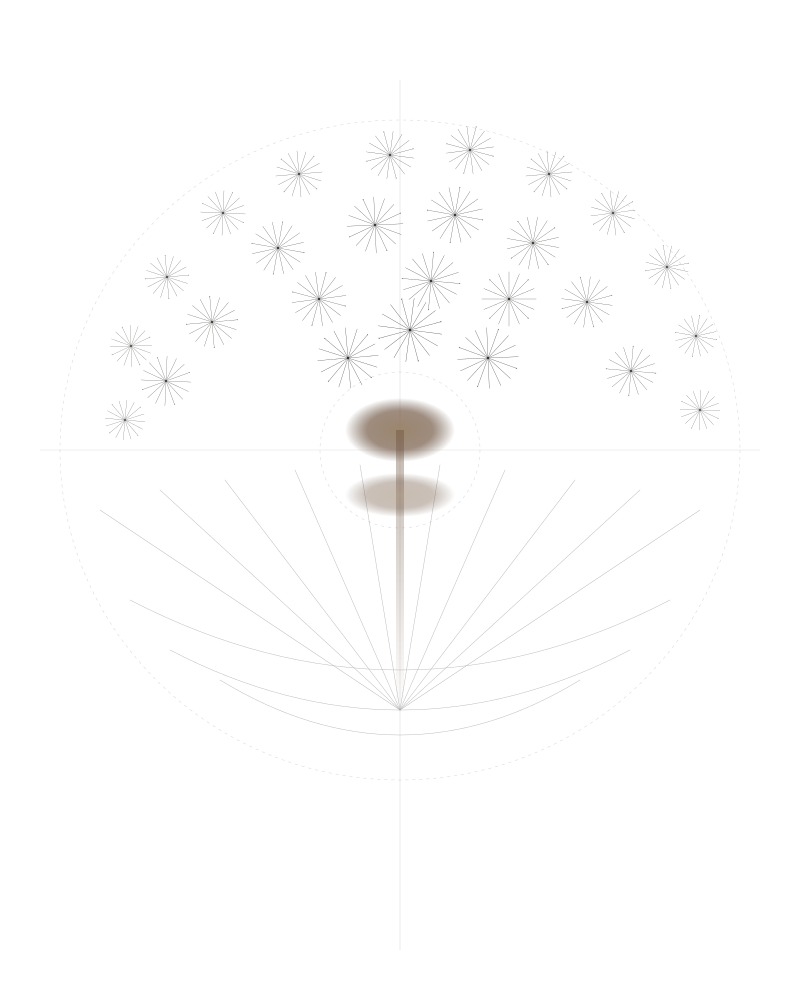
They are still there. The early summer dandelions have given their seeds — the late-season ones still stand, one with the pappus intact, held now between two fingers. The same structure that was described in the first essay of this series is present again. The two nested ellipsoids of the seed-bearing surface. The helical arrangement of the seeds across them. The fan of filaments around each seed. The ninety-two percent emptiness through which the air will flow when the seed lifts. Nothing has changed. The dandelion is the same dandelion.
It is worth standing with this for a moment before saying anything else. This flower head is, in every measurable feature, identical to the flower head described in the first essay of this series. The geometry is the geometry. The aerodynamics are the aerodynamics. The local rule that placed each seed at its position around the receptacle is the same Hofmeister rule that placed every dandelion seed since the species evolved its current form. None of this has been altered by the essays that followed.
The porosity of the pappus is approximately ninety-two percent. Each filament fan generates four times the drag of a solid disc of the same outer diameter. The separated vortex ring forms above the parachute when the seed begins to fall, holds its position relative to the seed, and remains stable as long as the wind speed stays below the threshold for which the porosity was tuned across millions of generations of evolution. Each seed in the head sits at 137.508 degrees from the previous one, on a helix climbing the surface of the outer ellipsoid. The arrangement maximises packing density under the constraint that no two seeds occupy the same angular position. None of this requires the dandelion to know what it is doing. The plant grows; the local rule applies at the growing tip; the Fibonacci geometry appears.
The same arrangement is in the sunflower, in the artichoke, in the pinecone, in every member of the Asteraceae family. The same Fibonacci spirals. The same golden angle. The same logical structure recurring through the same kind of growing tip in plants that may have last shared a common ancestor a hundred million years ago. The structure does not belong to any of them in particular. It is what local repulsion under iterative addition produces. It would appear in any system that arranged elements that way. It does appear — reliably — in every species whose growth follows the rule.
There is something worth pausing on here. This dandelion is small. It fits between two fingers. It weighs less than a gram. It is, by every reasonable measure, an ordinary thing — the kind of thing children blow at in summer fields, the kind of thing gardeners pull from their lawns as a weed. And yet what is held between two fingers is one of the most precisely engineered aerodynamic structures known to current biology, arranged according to a packing geometry that mathematicians proved optimal centuries after the dandelion was already using it — held together by local rules that have no representation of the global outcome they produce. The smallness of the object and the depth of what is happening inside it are not in proportion. The smallness is one of the things that makes the object what it is.
What has happened in the essays between the first one and this one has happened in the reader, not in the dandelion. The object has been the same throughout. The five essays in between have not added anything to the flower in hand. They may have changed how the flower is held. The flower itself has been waiting, unchanging, the whole time the essays were being read.
Stand with that for a moment. The dandelion did not need the essays. The essays needed the dandelion — as the object that made everything else visible. The dandelion was already what it is before any essay was written about it, and would have continued being what it is whether or not any essay had been written. It was waiting to be looked at carefully. The looking has happened. The dandelion has not changed.
The dandelion was the first substrate this series examined. It was not the only one. Across the five essays that followed, the same logical structure was traced through other substrates — substrates that share no developmental history, no molecular machinery, no design ancestry with the dandelion or with each other. The structure recurred anyway. This was the series' central observation.
The dandelion. The local Hofmeister rule, applied at each growing primordium, produces Fibonacci geometry across the seed head. The minimum-work principle, applied to the parachute structure under aerodynamic constraint, produces the four-fold drag enhancement that allows the seed to travel for kilometres on a summer breeze. Two local rules, running independently of any plan, producing two globally optimised outcomes. This was the opening case. The first substrate. The door into the rest.
The brain as inference machine, in the second essay. Predictive coding running through the cortical hierarchy produces coherent perception — the room experienced, the body sat in, the words on the page — without any single neuron knowing what the system as a whole is producing. Each neuron fires when its local prediction fails. The prediction error propagates upward. The model updates. The integrated experience appears as the running of all the local jobs together. The brain does not centralise consciousness in any single region. The brain is the integration of every local prediction-and-correction across its trillion synaptic connections, all of them running their own small variational machinery, none of them aware of what the whole is producing.
The self as the highest prior, in the third essay. Precision-weighting at the top of the predictive hierarchy produces the felt experience of being someone — the continuity across time, the location in space, the particular characteristics, the subject-of-experience to whom all of this is happening — without that experience being at the foundation of consciousness. The self is what the precision-weighting produces. It is one of the predictions the system runs. It is sustained by the default mode network, which consumes a disproportionate share of the brain's energy budget continuously running the experience of being someone. It is, structurally, the same kind of thing every other prediction is — a working model — held at higher precision than the others, present in ordinary experience as the felt ground of everything else.
The dissociation under load, in the fourth essay. What drops first under general anaesthesia, under classical psychedelics, and under high-performance flow tells what was not load-bearing for the system's continued operation. The self drops. The body persists. Three completely independent research traditions — anaesthesiology, psychopharmacology, and the psychology of skilled performance — converged on the same finding, by different methods, in different decades, with no coordination between them. The convergence was not anyone's hypothesis. It was what each of three separate investigations independently discovered. The ordering was the observation that the framework predicted and the data confirmed.
The territory beyond the self, in the first half of the fifth essay. Convergent reports across psychedelic research, long-form meditation, cardiac-arrest survivors, and contemplative traditions developed in mutual isolation across two thousand years described the same features when the self-prediction loses precision. No centre. No doer. No separation between awareness and what awareness is of. No passing of time in the ordinary sense. Four sources, four features, sixteen specific testimonies, one converged observation. The territory is reported the same way regardless of how one arrives at it.
The institutions of consensus, in the second half of the fifth essay. Language, education, economic structure, and modern media — the social and linguistic machinery in which every brain develops — train the self-prior to high precision in every individual they operate on. Not by intention. As a side effect of their function. The institutions need the self-model to do their work. The model gets trained to the precision the institutions require. Every utterance, every classroom question, every contract signed, every scroll through a feed is a small training instance for the prediction that there is a particular self at the centre of each individual's experience.
Six substrates. Same logical structure in each one. Local rules producing global outcomes that none of the local elements has access to. The Fibonacci spiral does not know it is being produced. The neurons do not know they are producing a self. The self does not know it is the highest prior. The institutions do not know they are training the prior. None of the local elements knows the global outcome. The global outcome appears anyway, reliably, by the running of the local rules.
Sit with the count. The investigation began with one object — a flower head small enough to hold between two fingers. From that one object, the same logical structure appeared in the brain, in the felt self, in the dissociation patterns, in the territory the dissociation reveals, in the institutions that train the prior the dissociation drops. Six substrates. None of them in conversation with the others. None of them sharing materials, methods, vocabulary, or research community. Each one ran by its own rules and produced its own version of the same structural observation.
This is what the series has been describing throughout. Not as theory imposed from outside. As what is observed across substrates that have nothing in common but their structural shape. Each essay was a different substrate. Each substrate ran by its own rules and its own materials. The structure recurred anyway. The recurrence is the finding. The count is the argument.
The phrase that gave the series its title is older than any of this. The line from the Tao Te Ching — attributed to Laozi around the fourth century before the present era — has been quoted, studied, and pondered in Chinese intellectual life for more than two thousand years. Tao produces one. One produces two. Two produces three. Three produces the ten thousand things. Read carefully — without the theological residue that has accumulated around it across the centuries — the line is a description of an iterative generative process. One principle. Step by step. Multiplication. The appearing world as what one principle produces when it keeps iterating.
This is what the series has shown across six substrates. This is what the dandelion is. This is what the brain is. This is what the institutions are. Local iteration. Apparent multiplicity. One principle running. The line is two and a half thousand years old. The series has, in its way, made it observable.
The series has not made any metaphysical claim. It has not said what the universe is. It has not said what consciousness is. It has not said what the Tao is. What it has done is trace one logical structure across six substrates and notice that the structure appears in each one. The observation is empirical and structural. The interpretation is left to the reader.
Notice what the observation has done. The dandelion was an object before the series. The dandelion is still an object. What has changed, possibly, is that the dandelion is now also visible as an instance — one local running of a principle that runs in many places. The reader who walks past a dandelion in a field tomorrow is not seeing something new. The reader is seeing the same thing they would have seen before, with one additional thing also visible — what this is also is.
The same is true of the brain. The same is true of the self. The same is true of the institutions of the reader's daily life. None of these things has changed. What may have changed is what the reader can hold them as. Not foundation. Not enemy. Not illusion. One local running of a principle that runs in many places — the principle the Tao Te Ching called by its own name, that the series has called by no name, and that does not require a name to be observable.
Something worth saying plainly here, because it is the question that often arrives at this point in an investigation like this one. What now? What does one do with the observation, once it has been made? Is there a practice that follows from it? An instruction? A programme?
The honest answer is that there is no required next step. The observation has been made or it has not. The reader who has noticed what the substrates have in common does not need to be told what to do about it — the noticing is what was being asked. There is nothing to do with the observation that is separate from the having of it. The dandelion in the field tomorrow will be visible the way it is visible. The room the reader sits in will be visible the way it is visible. The self the reader runs will continue running. None of this requires intervention. The looking has changed what is being looked at, and the change does not require effort to maintain. The reader who has noticed cannot un-notice. The noticing is now part of what the reader brings to the next dandelion.
If something does follow, it is small. The grip relaxes slightly on what was being gripped. The institutions continue their training but the prior they were training to such high precision becomes, gradually, slightly less precise — not because the reader is fighting the training, but because the reader has seen the training. What is seen as training stops training quite as effectively. This is not a programme. It is a side effect of having looked.
The principle does not require belief. It does not require practice. It does not require anything from the reader. It is what is observed when one looks carefully at how local rules produce global outcomes, in any substrate where this can be examined. The reader who has followed across six essays has done the looking. The looking is what was being asked.
The line that gave this series its title has been at the foot of every essay, as the two characters of 萬物 — the ten thousand things. It has appeared, unannounced, at the close of each piece. It is allowed to unfold now.